Installment #7: Bring on the Hoops; Snake Hate; and The Good Fans of Lakota
The Sacred Clown's Modern West Trilogy

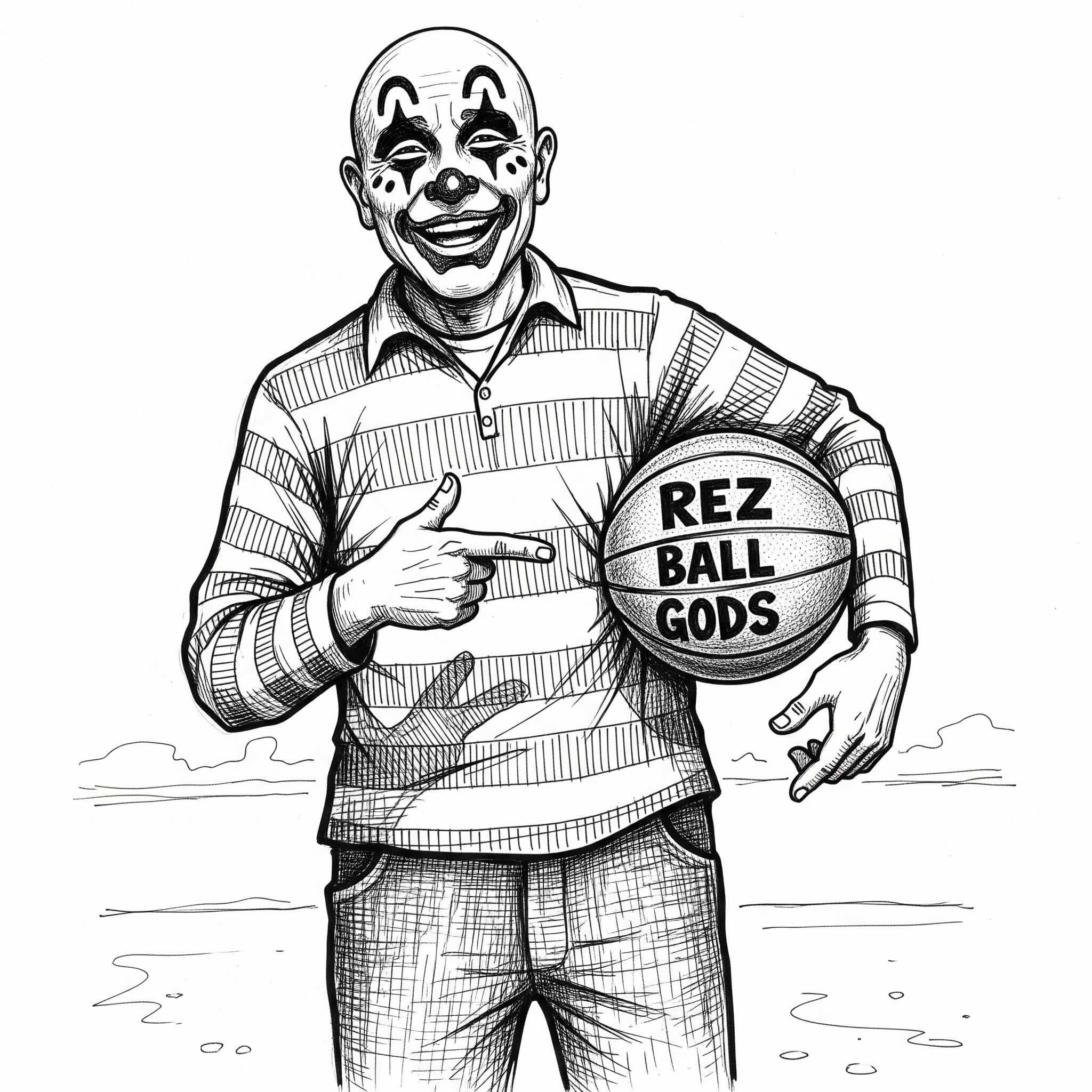
Bring on the Hoops
“When the radiator hisses in the cold gym, the star makes a big decision, and the headlines sneer, remember: the real heat always comes from the ones who know how to dance on cold floors.” ~ The Clown
The smell of stale Marlboros, fresh Brylcreem, and Pine Sol mixed in the sinus stuffing chill of the subzero North Dakota night. Earlier in the month Pearl Harbor shocked the World, and the Indians throughout the United States would volunteer for service in record numbers. There was no doubt, only resolve. In the meanwhile, tonight’s game might provide brief relief. The Elbowoods gym’s clapboard floor sighed thinking about how the Warriors would soon careen, prance, and tease the ball to provide the highest level of kinship that would rock the building.
The Clown slipped into the lonely radiator and assumed responsibility for warming the crowd. The observant couldn’t ignore the Clown’s synchronized hissing and belching every time a Warrior put the ball in the hoop. Tucked into the corner of the court, it was the earthly platform from which Johnny launched a jump shot that couldn’t be defended. That radiator was the unsung sixth man of the Warriors season.
During a time out Johnny’s felt his young bones ache. He’d told the team just before the game of his decision to enlist in the Marine Corps. He’d spilled the beans earlier in the day to his teammates. “You sure about this, Johnny?” his cousin asked.
“Yeah, straight to Camp Pendleton for infantry training after graduation,” he replied, his voice steady. The war promised even bigger thrills than winning basketball games over White towns. “This is my chance,” Johnny continued, “to rack up man victories, not just boy victories.” How do you explain that to your relatives who, at that very moment, were giddy, watching him from the bleachers and inhaling the stale and sweaty air of Elbowoods High School’s gym?
The earned art took over back on the court. Johnny called for the ball, careened off the side of the wall, pivoted 180 degrees in the air, planted his right foot on top of the hissing radiator, and leapt high beyond the reach of defenders to propel the leather sphere into the waiting net. You didn’t need eyes in the back of your head to play like these cousins. You just needed to feel the game, your teammates, the dirt court, and the sway of your ancestors. It also helped if the radiator was on your side.
As the Warrior’s fame spread, Odin sprang into action by salting the mines. Lutheran pastors throughout North Dakota were contacted in their dreams. “Tack epistles on your church doors. Be a modern day Martin Luther. Do Nordic society a favor. Expose these terrible Indians for the thieves they are. Uff da!”
The press needed no nudge to hop aboard what its editors heard as Sunday sermons. These were quickly turned into headlines by lazy editors for the next week’s editions of small town papers. Although sworn to Jesus and not to a pagan like Odin, the pastors’ DNA had outrun any qualms about furthering Nordic interests. Divine inspiration was always for sale and never far away.
As the 1941-42 season rolled on, the phrase “Sneaky Indians from the Missouri River Bottom Lands” began to catch on. Being called sneaky was maybe a left handed compliment and charitable North Dakotans thought that perhaps it wasn’t an insult as much as a tribute to those Indians whose had resisted having their lands had taken in battle.
The editorials emboldened the pastors. Sermons became even more shrill, spreading unvarnished opinions from the pulpit. Beyond simply extolling the next pancake breakfast sponsored by the Sons of Knute in the church basement the following week, they also found avenues to proclaim that all Indians are sneaky despite any good intentions they might harbor.
The Warriors and their families were used to character assassination, and that helped them to take this recent hub bub in stride. Who had time for newspapers? These papers always arrived a week late in Elbowoods anyway. You didn’t need to read the papers to know that this team was special. They were fast. They knew the jump shot. They knew the no look pass. Like the Clown, they knew a lot of things.
Piling on, the Bismarck newspaper suggested these Indians might be unfairly rich. “Sneaky Indians from the Valuable Missouri River Bottom Lands Upend North Dakota Basketball.” This was too much hilarity for Elbowoods. Rich? Who would have thought? Driving two decades-old cars down rutted gravel roads, eating cast off cheese from the Department of Agriculture, and living without electricity and we’re the rich ones? They knew more dog whistles were coming.
Snake Hate
“Sidewinders whisper the best advice—too bad most folks are too busy stomping or fretting to listen. Even the harmless ones know: humility slithers in where sense fears to crawl.” ~ The Clown
“Sidewinders whisper the best advice—too bad most folks are too busy stomping or fretting to listen. Even the harmless ones know: humility slithers in where sense fears to crawl.” ~ The Clown
Mamzer Hearsay hated snakes. So did Only Man, though for different reasons. Mamzer imagined them wriggling out of the mud walls of his rented earth lodge and circling his bed like scaly night watchmen. He didn’t need to worry. These weren’t the rattlers that sunned themselves atop Crow Flies High Butte, occasionally baptizing the unwary with venom. These were bullsnakes—no rattle, no poison, just freeloaders looking for cool mud in summer and warm dirt in winter.
Mamzer, however, was cursed. His sweat glands produced a brine that smelled like pickles long past their prime. His swollen ankle muffins dammed the scent inside his shoes. Every night bullsnakes frolicked by his bed, drunk on vinegar fumes, curling into makeshift hoops by swallowing their own tails, and dreaming of rolling across the prairie like slimy hula hoops.
The Clown regretted inventing snakes. They were sassy. Rattlers especially—forever bring him up short. “You don’t need that extra soup, tubby,” they hissed. “Wow, you really blew that one,” after some botched mortal intercession. They even needled Only Man, which guaranteed thunderous tantrums. “Odin is going to kick your bony Indian ass,” Only Man growled back.
Unlike Only Man, Mamzer never heard the wisdom in the snakes’ nagging—or any wisdom, really. Had he listened, he might have found peace in their company. Or at least borrowed a little common sense. Instead, he just sat in the dark, sweating vinegar, while a pile of sober snakes judged him by moonlight.
The Good Fans from Lakota
“The northern lights ain’t always lit, all pretty like and what not—sometimes you just get flickers, blackouts, and a gym full of Ice Holes doing their best to outshine their neighbors.” ~ The Clown
On game nights the Lakota High School gym guzzled more electricity than the rest of town did in a week. It was a luminescent treat for the good fans from Lakota because their own homes were much dimmer and not just measured in watts. Blackouts and brownouts were routine in North Dakota, but that didn’t stop the locals from blaming the government each time a bulb flickered. Conspiracy theories sprouted like dandelions: Washington wanted them dimly lit, probably so Norwegians would be forced to eat their lutefisk in their homes’ darkened corners.
“Fix Our Lights and Damn the Kerosene” became the rallying cry of would-be politicians. With enough believers and a promise of fresh fish pudding on election day, you could earn yourself a trip to Bismarck—where the real perks weren’t civic duty but whiskey, loose waitresses, and more than one working outlet.
Lakota’s school board, two generations earlier, had christened the team the “Ice Holes” in honor of Scandinavians’ obsession with drilling through frozen lakes. Poking at the ice with manual augers and crowbars in subhuman cold was a long standing winter pastime in the northern tier and had little to do whether there were actual fish present or not. When outsiders snickered at the name, the board doubled down. Once a Norwegian decides something’s honorable, it stays honored, no matter how much toilet humor it inspires.
By 1942 the Ice Holes cheer squad had perfected their act: “Hurrah, rah, sis, bah!” mixed with polite Norwegian thank-yous that sounded to outsiders like “tak scuddy ha.” It was quaint—until the war. With the Karlsruhe Komets, a German team, in town, the cheers curdled. Fueled by Akvavit, they morphed into: “Rah, rah, Lakota! Sis boom bah! Those Krauts will cry! Some will die! Tak scuddy ha!”
Sven Moses, face glowing brighter than a beetroot in January, bellowed it loudest while fumbling under Eric’s mother’s coats. Feeling this, she was forced to bust him with a wink a few times during the noisy part of the game. The Clown grinned. Akvavit was lightning in a bottle: Two pulls and suddenly everyone’s a patriot, a poet, and an honorary cousin of Paul Revere. The line between “Skol!” and “Skirmish!” is thinner than April ice on a North Dakota cow pond.
Halftime inhospitality sealed the insult. The Sons of Knute Ladies Auxiliary served the invading Germans only stale, half-burnt cookies. Fresh smultringer, sandkaker, and sirupsnipper stayed locked in the church basement until the last German bus rattled off into the night. Victory or defeat didn’t matter—Scandinavians weren’t about to waste good pig lard on an enemy.
The Karlsruhians groaned silently as they shuffled out, bad cookie crumbs stuck to their lips, facing a three-hour frozen drive home and a loss on the scoreboard. “Don’t let the gym door hit you in the keister,” yelled Eric’s mother. “Heil horseshit Hitler!” She seemed quite pleased by this utterance. The Clown, somewhere in the rafters, chuckled. Darkness, liquor, and bad cookies—perfect ingredients for small-town patriotism. A future generation might escape this mess. Not soon enough he thought.