
Episode Twenty-One
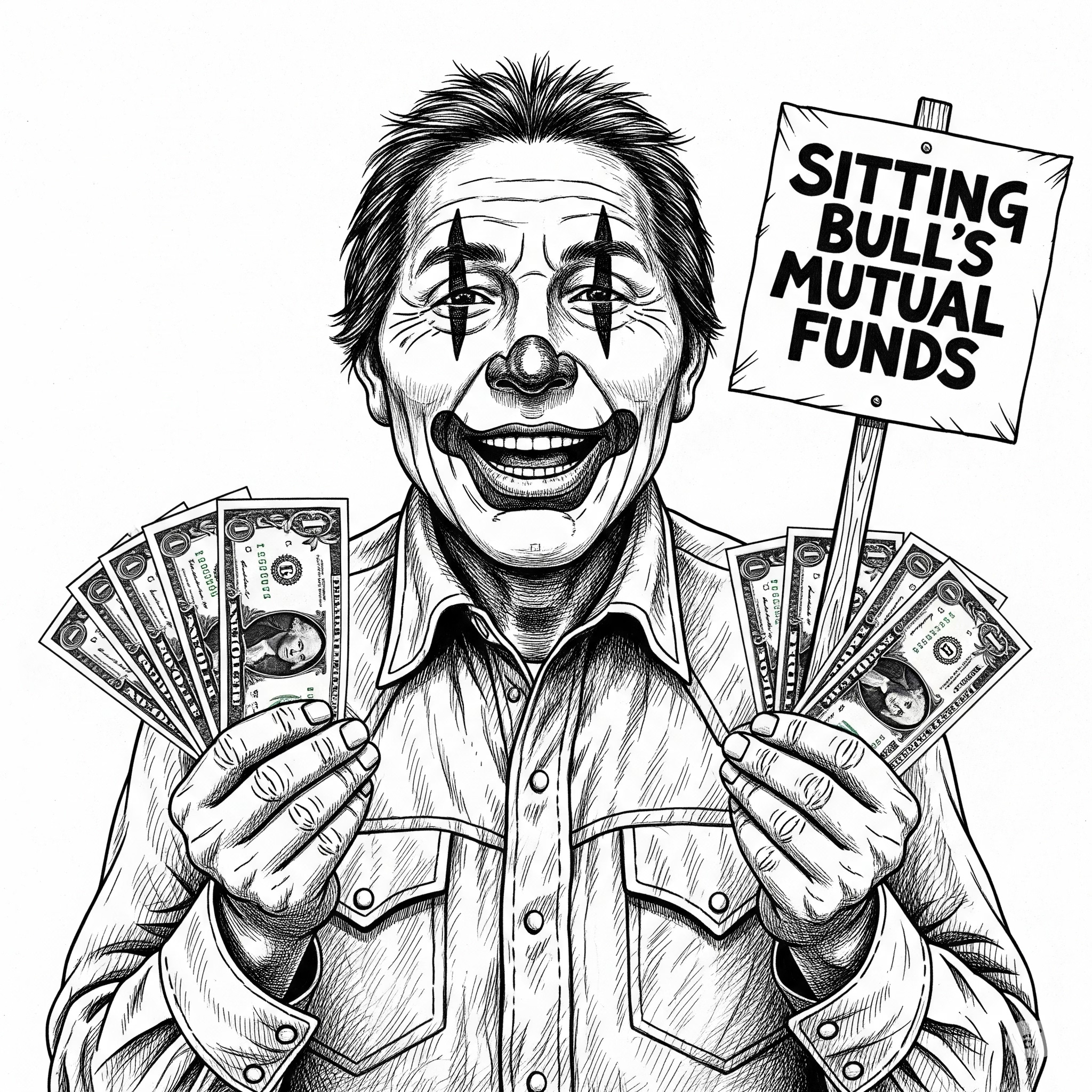
From Book 2 of the Sacred Clown's Modern West Trilogy, Sitting Bull's Mutual Funds

Fare Thee Well Amazon
“Paper blows away on the next wind; true hearts endure when the jungle is silent and the prairie is gone.” ~ The Clown
He’d ran back through the jungle feeling his way to Manaus. The plantation and its forced misery was behind him now, marked by the tear sliding down his cheek. It wasn’t easy haggling with the boat captain about the fare to New York but once he knew who his famous passenger was he’d welcomed him on board. The mushrooms and the dance were victories but he’d failed to bring peace to DestinyTerra. His request that the forest people be treated humanely and that their cultural practices be permitted had pissed Ambicioso off. “You come all the way down here to tell me what to do, Mr. Bull? You were supposed to subdue these people, make them walk on their knees, and make them happy about having a job they’d never have if it wasn’t for Mr. Rockwell!”
Not much surprised Sitting Bull. Exactly the same thing was happening back home. Whether in the Amazon or on Standing Rock, true hearts were easy to spot. A Lakota true heart would give you the fringe off his shirt and a flesh offering if you asked for it. Whites like Ambicioso and Rockwell would put both in their pockets without asking.
He fingered the paper that Ambicioso had thrust into his pocket as he was leaving. Now, on the boat, he pulled it out and examined it. It was written in English and Portuguese. Sitting Bull could pick out its true meaning.
“Pay to the bearer of this note, Mr. Sitting Bull, $10,000 for consulting services rendered to DestinyTerra Plantation and for travel expenses borne therewith. This note is not negotiable as US Tender and is never intended to be. Instead, it has been proffered to Mr. Bull as a mutual fund in which risk is spread unevenly between rube creators and the rubes themselves. Should said plantation succeed in subjugating the forest dwellers so that said plantation turns a profit, this situation could change but it is doubtful that any tycoon would wish to share what he rightfully has plundered and stole.”
And they said he couldn’t read. Of course he could. He understood exactly how Ambicioso had tried to make him the fool. Hadn’t Buffalo Bill also tried the same trick, paying him with worthless paper? Scrip. Sheez. Chun. Yawning, he reminisced about Buffalo Bill’s show. Even the friends he’d made among the cowboys were mostly moral misfits. Some had even said they wished they weren’t shooting blanks when the Lakota performers attacked the stagecoach. “Real bullets for real Indians,” they’d laugh after the show. Of course, the cowboy oath wouldn’t allow them to shoot anyone who didn’t deserve it. Or would it? Did the cowboys actually take a cowboy oath? One that would require them to sacrifice part of themselves for the betterment of others? Sitting Bull could see little difference between a joke and a bullet.
European crowds, especially the Germans, felt a kinship with the Lakota—noble people of the campfire, singing in octaves neither Wagner nor Bach would countenance, practicing nobility in every breath, living what seemed the most virtuous of lives. Weren’t they, the Germans believed, heirs to long-lost Teutonic tribes, the original Indians of Europe? Other Europeans weren’t blessed like Germans; shouldn’t that twitching terror of vanquishing lesser Europeans be a lifestyle?
A true hijack job, Sitting Bull thought. Impersonating Lakota. Running through their countryside, staging pretend conquests, understanding nothing of true Lakota kinship. They punched down while the Lakota punched up, mistaking the killing of unsuspecting neighbors and a mock “Indian dance” in dime-store feathers for the essence of being Indian—mere performance art. Sitting Bull knew these German imposter Indians would never stoop to care for the elderly and vulnerable; they saw lesser humans only as roadblocks to their version of Indianness. Covering innate German despair, Indians were celebrated in lecture halls and in sweat-stained barrooms. A nation ripe for fascists, he mused.
Sitting Bull shook these thoughts away. He fixed his gaze ahead and took in the mixed smell of decay and growth wafting from the jungle. How had a carefree childhood on what the whites called the Great Plains come to this in his older years? Why was he chosen to carry the message of taking care of one another and respecting all creatures, both animal and human? How had his burdens been picked? Wouldn’t it have been better to have died at the Battle of Greasy Grass instead of making the Big Medicine that meant the Sioux win? Why had he consented to come to the Amazon? Mumbling quietly to himself so the toothless sailors couldn’t hear, he thought ahead to his return to Standing Rock and to meeting his fate. He fingered the Little Ones in his pouch. They squealed.
The House Always Wins
“It’s all funny until you try to spend it.” ~ The Clown
In 1889, Bismarck was barely a hick town. Sitting Bull stepped down from the train, his eyes fixed on the few new storefronts that had been built since he’d last seen the place. Facades meant to emulate European streets. High gables that lent the impression of grandeur to clapboard businesses slapped together and facing the dirt main street. His eyes tripped over one new building with a freshly painted sign, “J.P. Morgan Asset Management.” Carved beavers adorned both sides of the door. He fingered Ambicioso’s paper and stepped inside.
Oblivious to the gathering crowd outside, he waved the scrip and inquired whether anyone might be able to assist him. A young, sickly face looked up from behind horn-rimmed glasses and waved him to his desk. “How may I help you, Mr...?”
“Sitting Bull,” the old chief said. “Lakota Chief.”
“Of course! I’ve seen your photograph many times! How are you, Mr. Bull?”
“I’m fine. How are you?”
“Tolerably well, considering how cold it’s been. Last night was thirty below.”
“The train from Minneapolis was colder than a five-day-old dead buffalo. It was freezing all the way from New York, but the Twin Cities took the cake. I’m glad to be near home.”
“Welcome back. Where are you coming from?”
“I started this journey in the Amazon, among the forest dwellers.”
“The forest? Redwoods, oak trees, and chestnuts?”
“No. Rubber trees.”
“Oh, I’ve read about those. Must have been a pleasant trip.”
“It was a horrible trip. Belching steam trampers, uncomfortable train seats, toothless sailors, bewitched plantation overseers, and only little sandwiches to eat. All of this to help the forest dwellers.”
“I’m sorry.”
“So am I. But at least I brought back songs and a dance that my people will appreciate. And this paper.” He pushed the scrip it across the desk. “I believe this is worth money. How’s your Portuguese?”
Schultz poured over the note, clicking his tongue. He grimaced, then smiled. “I’ve never seen a promissory note quite like this, Mr. Bull. As the word ‘promise’ is in the name, it’s intriguing. But on close inspection, I fear it’s worthless.”
“That’s not how I read it, sir. It looks to me that if Rockwell and Ambicioso make a go of it down there in the jungle, that promissory note will be worth considerable money.”
“I read that too, Mr. Bull. Yes, the document does say that. But it also indicates that it was never intended to be US Tender. It also uses the words ‘rube creators’ and ‘rubes themselves.’ You do understand what a rube is, right?”
Rising from his chair, Sitting Bull snatched the paper back. “I think I’m looking at a rube right now. Do you understand the word ‘mutual’? Do you know it means when I win, you win? Or conversely, when I lose, you also lose?”
“In the financial business, Mr. Bull, ‘mutual’ always means the house wins and the rubes lose.” Schultz smiled with genuine regret. “I’m sorry to present you with this unsettling news. Good day and best wishes.”
Sitting Bull turned and walked toward the door. Behind him, Schultz called out softly, almost to himself: “The Indians taught us everything about the land, and we repaid them by teaching them about the markets.”
Outside, the wind picked up, scattering snow across the Bismarck street. Sitting Bull stood for a moment, holding Ambicioso ’s worthless paper, watching it flap like a trapped bird in his palm. True hearts endure, he thought, *but the paper? The paper blows away.*
The Clown’s whisper came on the wind: “Promise anything. Deliver nothing. Call it finance.”